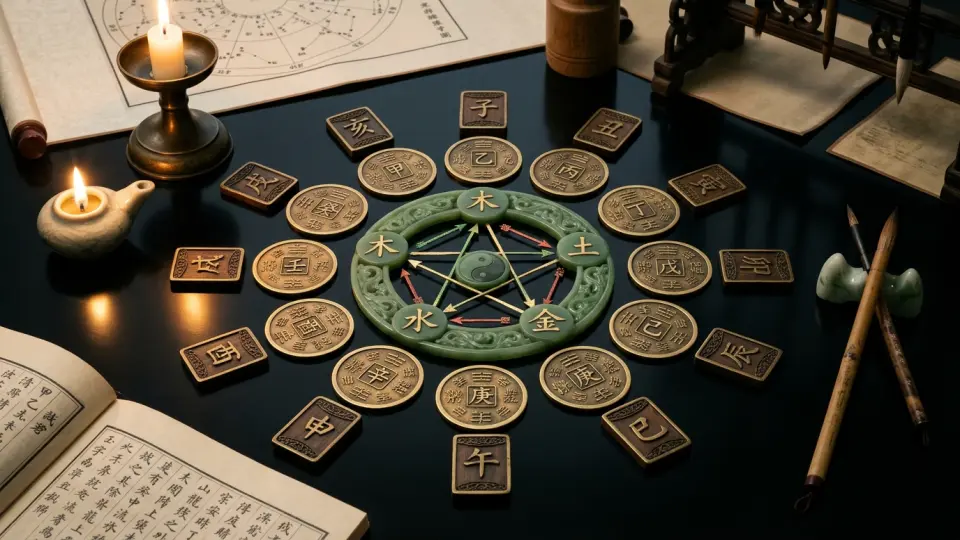
Concept 01 · 日主與旺衰
The 10 Day Masters (日主) & Why "Strong vs. Weak" Flips Your Chart
In classical Ziping Ba Zi (子平八字), the Day Master (日主, Rì Zhǔ, or Day Stem 日干) is the Heavenly Stem of your Day Pillar. While popular horoscopes look only at your birth-year animal (the Year Branch—one of eight characters), Ba Zi centers the entire chart on the Day Master: your Year Pillar governs ancestral roots and early environment, your Month Pillar governs career and seasonal authority (月令提綱), your Day Branch is the Spouse Palace (夫妻宮), and your Hour Pillar governs long-term ambitions, children, and late-life legacy.
| Day Master | Polarity & Element | Classical Archetype (滴天髓) | Primary Wealth Mode | Classical Organ (臟腑) | Nobleman (天乙貴人) |
|---|---|---|---|---|---|
| 甲 jiǎ | Yang Wood | The Tall Oak | Direct Wealth | Gallbladder | Ox, Goat |
| 乙 yǐ | Yin Wood | The Climbing Vine | Direct Wealth | Liver | Rat, Monkey |
| 丙 bǐng | Yang Fire | The Radiant Sun | Indirect Wealth | Small Intestine | Pig, Rooster |
| 丁 dīng | Yin Fire | The Steady Candle | Indirect Wealth | Heart | Pig, Rooster |
| 戊 wù | Yang Earth | The Great Mountain | Direct Wealth | Stomach | Ox, Goat |
| 己 jǐ | Yin Earth | The Garden Soil | Direct Wealth | Spleen | Rat, Monkey |
| 庚 gēng | Yang Metal | The Sword / Raw Ore | Indirect Wealth | Large Intestine | Ox, Goat |
| 辛 xīn | Yin Metal | The Jewel / Refined Metal | Indirect Wealth | Lung | Tiger, Horse |
| 壬 rén | Yang Water | The Ocean / Great River | Direct Wealth | Bladder | Rabbit, Snake |
| 癸 guǐ | Yin Water | The Rain / Mountain Spring | Direct Wealth | Kidney | Rabbit, Snake |
Engine-Locked Proof · Why Day Master Identity Alone Is Never Enough
Same 丙 (Yang Fire) Day Master — 100% Opposite Useful Gods (用神)
A common beginner mistake is asking, "I am a Yang Fire (丙火) Day Master—is Fire or Wood good for me?" Without weighing seasonal command (得令) and hidden-stem rooting (通根), that question has no valid answer. Compare these two real charts computed by our Swiss Ephemeris engine—both belong to 丙 (Yang Fire) Day Masters, yet every favorable and unfavorable element flips:
June 11, 1986 · 12:00 · Singapore (午 Horse Month — Peak Summer Fire)
Why it is Strong (68.0% > 55% threshold):
Born in the 午 Horse month (peak summer Fire) with 寅·午·戌 completing the full Fire Three-Harmony frame (三合火局).
Weighted counts: Fire 4.7 + Wood 2.1 = 6.8 / 10.0 points supporting the self.
Useful Gods (用神 / 喜神): Earth, Water, Metal — vents, cools, and channels excess heat.
Unfavorable (忌神): Wood, Fire — adding more Fire or Wood causes 火炎土燥 (scorched imbalance).
December 16, 1992 · 22:00 · Singapore (子 Rat Month — Peak Winter Water)
Why it is Weak (25.0% < 38% threshold):
Born in the 子 Rat month (mid-winter Water) with dual 壬 Yang Water stems clashing 丙 (丙壬沖).
Weighted counts: Water 3.8 + Earth 2.3 + Metal 1.4 = 7.5 / 10.0 points draining/opposing the self; only 寅 Tiger Wood roots the Day Master.
Useful Gods (用神 / 喜神): Wood, Fire — feeds and re-ignites the winter sun.
Unfavorable (忌神): Water, Earth, Metal — extra Water or Earth extinguishes and dims 丙 Fire.
Concept 02 · 用神與五行偏枯
Useful God (用神) & What "Too Much Fire, Water, Metal, Earth, or Wood" Actually Means
After plotting a chart, two questions dominate search queries: "What is my Useful God (用神, Yòng Shén)?" and "My chart has too much Fire (or no Water)—how do I fix it?" In our calculation engine (`FourPillars.get_element_counts()`), every visible Heavenly Stem contributes 1.0 point, every Earthly Branch main qi contributes 0.5 points, and the branch's Hidden Stems (藏干, Cáng Gān) contribute 1.0 point split by classical percentage (for example, 未 Goat holds 己 Earth 60%, 丁 Fire 30%, and 乙 Wood 10%). Across four complete pillars, the chart totals 10.0 points.
1. Standard Structure (正格)
Applies when no single element exceeds 70% of the chart. Classification uses two boundaries: Strong (>55% support), Balanced (38%–55% support), or Weak (<38% support). Balanced and Weak charts favor Resource (印) and Companion (比劫); Strong charts favor Output (食傷), Wealth (財), and Officer (官殺).
2. Dominant & Follow Structures (專旺 / 從格)
When one element exceeds 70% of total chart weight, normal suppression fails ("fighting a tidal wave breaks the dam"). If the dominant element is Self/Resource, the chart forms a Dominant (專旺格) structure; if it is Output/Wealth/Officer, it forms a Follow Leader (從格) structure that goes with the dominant current.
3. Why "Missing Element = Useful God" Is False
If your chart has 0% Metal, naive apps tell you to wear white or gold. But if you are a Weak Wood Day Master, Metal is the element that chops Wood (官殺攻身)—its absence is actually protecting you! Always check Day Master strength before supplementing a zero-count element.
| Imbalance Pattern | Classical Principle (五行生克制化) | How It Shows Up in Chart Dynamics | Classical Balancing Remedy (調候 / 通關) |
|---|---|---|---|
|
Too Much Fire (火多) or Missing Water |
火多金熔 · 火多木焚 Excess Fire melts Metal & incinerates Wood |
Rapid ignition, high urgency, restlessness, or burnout—especially amplified during 2026 (丙午 Fire Horse) and 2027 (丁未 Fire Goat). | Vent with Damp Earth (辰 / 丑) to absorb heat and generate Metal, plus Water (壬 / 亥 / 子) for temperature regulation (調候). |
|
Too Much Water (水多) or Missing Fire |
水多木漂 · 水多土流 Excess Water sets Wood adrift & washes Earth away |
Over-analysis, strategic hesitation, constant motion without anchoring, or winter-born charts lacking warmth (寒局). | Channel with Wood (甲 / 寅) to absorb the flood into growth, or dikings of Yang Earth (戊 / 戌) plus 丙 Fire to warm the chart. |
|
Too Much Metal (金多) or Missing Wood |
金多水濁 · 金多木折 Excess Metal muddies Water & snaps Wood |
Perfectionism, rigid standards, over-pruning new ideas before they root, or sharp interpersonal boundaries. | Draw out with Water (壬 / 癸, 金白水清) so Metal flows into wisdom, or forge with Fire (丁火煉金) into useful tools. |
|
Too Much Earth (土多) or Buried Metal |
土多金埋 · 土多水滯 Excess Earth buries Metal & dams Water |
High endurance and loyalty paired with inertia, over-caution, or hidden talent that struggles to surface (金埋). | Loosen with Yang Wood (甲木疏土) to break stasis, and vent through Metal (庚 / 辛 / 申 / 酉) so stored value emerges. |
|
Too Much Wood (木多) or Choked Fire |
木多火熾 · 木多金缺 Excess Wood smothers Fire & blunts Metal |
Sprawling initiatives, over-commitment across too many branches at once, or stubborn resistance to pruning. | Prune with Metal (庚金劈甲) to shape timber, and vent into Fire (丙 / 丁, 木火通明) for clear creative output. |
Concept 03 · 十神推導與生克
The Ten Gods (十神): Complete Abbreviation & 5×5 Element Derivation Matrix
Despite the dramatic English translation, the Ten Gods (十神, Shí Shén) are not deities. They are the five elemental relationships (比劫 · 食傷 · 財星 · 官殺 · 印星) multiplied by two Yin/Yang polarity states (`5 × 2 = 10`). When a relationship shares your Day Master's exact Yin/Yang polarity (`Yang + Yang` or `Yin + Yin`), classical Ba Zi views the interaction as dynamic, unrestrained, or indirect (偏); when it has the opposite polarity (`Yang + Yin`), the interaction is structured, reciprocal, and steady (正).
| Ten God & Code | Chinese / Pinyin | 5-Category Group | Derivation Rule (vs. Day Master) | Classical Life Domain & Expression |
|---|---|---|---|---|
| Companion F | 比肩 bǐ jiān | 比劫 Companion | Same element, same Yin/Yang polarity | Self-autonomy, peers, siblings, competitive stamina |
| Rob Wealth RW | 劫财 jié cái | 比劫 Companion | Same element, opposite Yin/Yang polarity | Social reach, bold alliances, resource competition, spending pressure |
| Eating God EG | 食神 shí shén | 食伤 Output | Element produced by Day Master, same polarity | Refined craftsmanship, steady expression, appetite, strategic patience |
| Hurting Officer HO | 伤官 shāng guān | 食伤 Output | Element produced by Day Master, opposite polarity | Disruptive innovation, debate, challenging convention, rapid execution |
| Direct Wealth DW | 正财 zhèng cái | 财星 Wealth | Element controlled by Day Master, opposite polarity | Earned salary, steady enterprise, auditable assets, operational stewardship |
| Indirect Wealth IW | 偏财 piān cái | 财星 Wealth | Element controlled by Day Master, same polarity | Windfalls, portfolio allocation, market timing, multi-stream ventures |
| Direct Officer DO | 正官 zhèng guān | 官杀 Influence | Element that controls Day Master, opposite polarity | Institutional authority, governance, reputation, rule-bound leadership |
| Seven Killings 7K | 七杀 qī shā | 官杀 Influence | Element that controls Day Master, same polarity | High-pressure command, crisis decisiveness, fierce competition, grit |
| Direct Resource DR | 正印 zhèng yìn | 印星 Resource | Element that produces Day Master, opposite polarity | Classical scholarship, mentorship, credentials, protective shelter |
| Indirect Resource IR | 偏印 piān yìn | 印星 Resource | Element that produces Day Master, same polarity | Non-linear intuition, esoteric research, contrarian strategy, independence |
| Your Day Master Element | 比劫 Companion Same Element (F / RW) |
食傷 Output DM Produces (EG / HO) |
財星 Wealth DM Controls (DW / IW) |
官殺 Officer / 7K Controls DM (DO / 7K) |
印星 Resource Produces DM (DR / IR) |
|---|---|---|---|---|---|
|
Wood 甲 (Yang) / 乙 (Yin) |
Wood (甲 (Yang), 乙 (Yin)) | Fire (丙 (Yang), 丁 (Yin)) | Earth (戊 (Yang), 己 (Yin)) | Metal (庚 (Yang), 辛 (Yin)) | Water (壬 (Yang), 癸 (Yin)) |
|
Fire 丙 (Yang) / 丁 (Yin) |
Fire (丙 (Yang), 丁 (Yin)) | Earth (戊 (Yang), 己 (Yin)) | Metal (庚 (Yang), 辛 (Yin)) | Water (壬 (Yang), 癸 (Yin)) | Wood (甲 (Yang), 乙 (Yin)) |
|
Earth 戊 (Yang) / 己 (Yin) |
Earth (戊 (Yang), 己 (Yin)) | Metal (庚 (Yang), 辛 (Yin)) | Water (壬 (Yang), 癸 (Yin)) | Wood (甲 (Yang), 乙 (Yin)) | Fire (丙 (Yang), 丁 (Yin)) |
|
Metal 庚 (Yang) / 辛 (Yin) |
Metal (庚 (Yang), 辛 (Yin)) | Water (壬 (Yang), 癸 (Yin)) | Wood (甲 (Yang), 乙 (Yin)) | Fire (丙 (Yang), 丁 (Yin)) | Earth (戊 (Yang), 己 (Yin)) |
|
Water 壬 (Yang) / 癸 (Yin) |
Water (壬 (Yang), 癸 (Yin)) | Wood (甲 (Yang), 乙 (Yin)) | Fire (丙 (Yang), 丁 (Yin)) | Earth (戊 (Yang), 己 (Yin)) | Metal (庚 (Yang), 辛 (Yin)) |
Concept 04 · 伏吟反吟與刑沖合害
Fu Yin (伏吟), Fan Yin (反吟), Clashes (六沖), Harmonies & Three Punishments (三刑)
A Ba Zi chart is not static: its four natal pillars interact with one another and with every incoming 10-Year Luck Pillar (大運) and Annual Pillar (流年). Whenever an interaction triggers, classical readers check two things: which mechanic fired (harmony, clash, Fu Yin echo, punishment, or harm) and which life palace (宮位) it struck: Year Pillar (social reputation and family roots), Month Pillar (career and public life), Day Pillar (self and close relationships), or Hour Pillar (ambitions and long-term plans).
| Interaction Type | Exact Branch / Stem Pairs | Engine Detection Rule & Classical Interpretation |
|---|---|---|
|
Fu Yin (伏吟) Palace Echo / Duplication |
Identical adjacent natal branches (e.g. Month 午 + Day 午) or identical annual/natal pillar (e.g. 1967 丁未 in 2027 丁未 — see Fire Goat 60-year return). | Signals internal repetition, intensification, or a "double-mirror" test in the affected palace. When the duplicated branch is 辰, 午, 酉, or 亥, our engine flags Fu Yin with Self-Penalty (伏吟兼自刑)—inviting conscious pacing rather than impulsive overhaul. |
|
Six Clashes (六沖) & Fan Yin (反吟) |
子午 (Rat–Horse) · 丑未 (Ox–Goat) · 寅申 (Tiger–Monkey) · 卯酉 (Rabbit–Rooster) · 辰戌 (Dragon–Dog) · 巳亥 (Snake–Pig) | 180° zodiac opposition. Fan Yin (反吟) is a full stem-and-branch clash (such as 庚子 clashing 丙午 in 2026, or 辛丑 clashing 丁未 in 2027). Clashes uproot stagnation: they trigger relocation, career shifts, or relationship renegotiation—favorable when they break open a rigid 忌神 storage branch, disruptive when they uproot your Useful God. |
|
Six Harmonies (六合) Secret Friends |
子丑 → Earth (Rat–Ox) · 寅亥 → Wood (Tiger–Pig) · 卯戌 → Fire (Rabbit–Dog) · 辰酉 → Metal (Dragon–Rooster) · 巳申 → Water (Snake–Monkey) · 午未 → Fire (Horse–Goat) | One-to-one magnetic pairing (such as 午未合火 linking 2026 Horse and 2027 Goat). Stabilizes the palace it touches, builds diplomatic alliances, and can soften an incoming clash (合處逢沖 / 沖中逢合). |
|
Three Harmonies (三合局) Elemental Trines |
寅午戌 → Fire (Tiger · Horse · Dog) · 巳酉丑 → Metal (Snake · Rooster · Ox) · 申子辰 → Water (Monkey · Rat · Dragon) · 亥卯未 → Wood (Pig · Rabbit · Goat) | Unites the Birth (長生), Peak (帝旺), and Storage (墓庫) branches of an element. Two present branches form a Half-Trine (半合); all three form a full elemental frame that strongly shifts chart balance toward the produced element. |
|
Three Punishments (三刑) & Self-Penalty (自刑) |
Ungrateful (無恩): 寅巳申 (Tiger·Snake·Monkey) Bullying (恃勢): 丑戌未 (Ox·Dog·Goat) Uncivilized (無禮): 子卯 (Rat·Rabbit mutual pair) Self-Penalty (自刑): 辰辰 · 午午 · 酉酉 · 亥亥 |
Our engine (`get_branch_interactions`) requires 2+ distinct branches for multi-branch punishments (so two 子 alone never falsely trigger 子卯). Punishments indicate internal friction, contract disputes, or perfectionist self-sabotage rather than external collision. |
| Six Harms (六害 / 穿) | 子未 (Rat–Goat) · 丑午 (Ox–Horse) · 寅巳 (Tiger–Snake) · 卯辰 (Rabbit–Dragon) · 申亥 (Monkey–Pig) · 酉戌 (Rooster–Dog) | Formed when a branch clashes with your Secret Friend (六合 partner). Represents subtle friction, miscommunication, or unmet expectations in the affected palace (such as 子未害 Rat–Goat in 2027). |
Concept 05 · 神煞與空亡
Symbolic Stars (神煞): Peach Blossom (桃花), Sky Horse (驛馬), Nobleman & Void (空亡)
While the Five Elements and Ten Gods form the structural spine of a Ba Zi reading, Symbolic Stars (神煞, Shén Shà) act as high-resolution lenses for specific life themes: social magnetism and romance (Peach Blossom 桃花), relocation and global career momentum (Sky Horse 驛馬), intellectual and artistic solitude (Canopy 華蓋), and mentor rescue (Heavenly Nobleman 天乙貴人, listed for all 10 Day Masters in Table 1 above).
| Day or Year Branch Frame (三合局) | 桃花 Peach Blossom Charisma, Attraction & Audience |
驛馬 Sky Horse Travel, Relocation & Career Pivot |
華蓋 Canopy Star Research, Metaphysics & Mastery |
|---|---|---|---|
| Fire Frame · 寅午戌 (Tiger · Horse · Dog) | 卯 · Rabbit (Wood) | 申 · Monkey (Metal) | 戌 · Dog (Earth) |
| Water Frame · 申子辰 (Monkey · Rat · Dragon) | 酉 · Rooster (Metal) | 寅 · Tiger (Wood) | 辰 · Dragon (Earth) |
| Metal Frame · 巳酉丑 (Snake · Rooster · Ox) | 午 · Horse (Fire) | 亥 · Pig (Water) | 丑 · Ox (Earth) |
| Wood Frame · 亥卯未 (Pig · Rabbit · Goat) | 子 · Rat (Water) | 巳 · Snake (Fire) | 未 · Goat (Earth) |
Internal vs. External Peach Blossom (牆內桃花 vs. 牆外桃花)
Location decides how a Peach Blossom star behaves. When your Peach Blossom branch sits in the Year or Month Pillar ("Inside the Wall," 牆內桃花), it expresses as natural warmth, early social grace, and harmonious bond within marriage. When it sits in the Hour Pillar ("Outside the Wall," 牆外桃花), it radiates outward as public charisma, audience magnetism, client attraction, or late-stage romantic attention.
Death and Emptiness (空亡, Kong Wang)
In the 60-year Sexagenary Cycle (六十甲子), ten Heavenly Stems pair with twelve Earthly Branches in six 10-pillar blocks (六甲旬). Each 10-day block leaves two Earthly Branches unpaired—the Void (空亡) branches. A void branch reduces purely material attachment in that palace while heightening strategic, spiritual, or unconventional insight.
From Concept Lookup to Your Personal Chart
See Your Exact Day Master Strength, Useful God (用神) & 2026–2030 Horizon
Plot your four pillars and weighted Five Elements free in 30 seconds—or order the complete 18-page Full Ba Zi Dossier ($38.88) for your full Day Master strength classification, Favorable & Unfavorable Elements, 10-Year Da Yun (大運) 5+5 decadal rhythm, and .
Questions Answered · 常見命理問題
Frequently Asked Questions About Ba Zi Concepts & Chart Labels
What is the Day Master in a Ba Zi chart, and is a 'Weak' Day Master bad?
Your Day Master (日主, Rì Zhǔ) is the Heavenly Stem of your Day Pillar — one of the ten stems (甲 through 癸) that represents the core self in Four Pillars astrology. A 'Weak' Day Master (身弱) is not a character flaw or bad luck; it simply means the supporting elements in your chart (your own element plus the Resource element that generates it) account for less than 38% of your weighted elemental qi once birth season and hidden stems are counted. A Weak Day Master thrives when supported by Resource (印星) and Companion (比劫) elements, whereas a Strong Day Master (身強, above 55% support) thrives when channeled through Output (食傷), Wealth (財星), and Officer (官殺) elements.
What does 'too much Fire' (or too much Water, Metal, Earth, or Wood) mean in a Ba Zi chart?
When a chart shows 35% to 55%+ of a single element—such as 'too much Fire' (火多) during the 2026 Fire Horse (丙午) and 2027 Fire Goat (丁未) cycle—classical Ba Zi diagnoses it through the five-element cycle rather than treating the excess element in isolation. Excess element qi presses on three neighbors at once: it over-controls the element it conquers (excess Fire melts Metal, 火多金熔), over-drains the Mother element that feeds it (excess Fire exhausts Wood, 火多木焚), and parches the system unless vented into its Output element (Earth, 食傷洩秀) or balanced by its Controlling element (Water, 調候).
How do the Ten Gods (十神) work, and what do abbreviations like 7K, DO, EG, HO, DW, IW, DR, IR, RW, and F mean?
The Ten Gods (十神, Shí Shén) are relational labels derived mathematically by comparing any stem or hidden stem in your chart against your Day Master across two rules: the Five-Element cycle and Yin/Yang polarity. Same element gives Companion (比肩, F) for matching polarity or Rob Wealth (劫財, RW) for opposite polarity. The element your Day Master produces gives Eating God (食神, EG) or Hurting Officer (傷官, HO). The element your Day Master controls gives Indirect Wealth (偏財, IW) or Direct Wealth (正財, DW). The element that controls your Day Master gives Seven Killings (七殺, 7K) or Direct Officer (正官, DO). The element that produces your Day Master gives Indirect Resource (偏印, IR) or Direct Resource (正印, DR).
What is the Useful God (用神 / Yong Shen) and why can't a simple element counter find it?
The Useful God (用神, Yòng Shén) is the specific element your chart requires to reach structural equilibrium and seasonal comfort (調候). Naive online calculators often pick whichever element has the lowest raw count (zero or one occurrence) and call it your favorable element. In classical Ba Zi (Ziping method, 子平法), a missing element can actually be an Unfavorable God (忌神) if your Day Master is Weak and that missing element would drain or attack it further. Finding the true Useful God requires weighing seasonal command (月令) first, then branch rooting (通根), and checking whether the chart crosses the 70% threshold into a Follow (從格) or Dominant (專旺格) structure.
What is Fu Yin (伏吟) and Fan Yin (反吟) in a Ba Zi chart?
Fu Yin (伏吟, 'hidden groaning' or 'palace echo') occurs when two adjacent natal pillars—or an incoming annual/luck pillar and a natal pillar—share the exact same Earthly Branch or identical stem-branch pair (for example, a 1967 丁未 Fire Goat native entering the 2027 丁未 Fire Goat year). Fu Yin signals internal repetition, intensification, and a call for deliberate pacing in that pillar's life palace—especially when the branch is one of the four self-punishment branches (辰, 午, 酉, 亥). Fan Yin (反吟, 'reverse echo') is the opposite: two pillars in direct six-clash opposition (六沖), signaling external disruption, relocation, or structural pivot.
What do the Uncivilized Punishment (子卯), Ungrateful Punishment (寅巳申), and Bullying Punishment (丑戌未) mean?
The Three Punishments (三刑, Sān Xíng) describe high-friction branch combinations that test judgment rather than open opposition. Ungrateful Punishment (無恩之刑, 寅巳申 — Tiger, Snake, Monkey) involves three Traveling Horse (驛馬) branches colliding in fast-moving career or contractual friction. Bullying Punishment (恃勢之刑, 丑戌未 — Ox, Dog, Goat) involves three Earth storage branches competing for authority and territorial control. Uncivilized or Discourteous Punishment (無禮之刑, 子卯 — Rat and Rabbit) is a mutual pair between pure Water and pure Wood that tests boundaries, candor, and interpersonal respect.
How are Symbolic Stars (神煞) like Peach Blossom (桃花), Sky Horse (驛馬), and Heavenly Nobleman (天乙貴人) calculated?
Symbolic Stars (神煞, Shén Shà) are secondary lookup markers anchored to your Day (or Year) Stem and Branch. Peach Blossom (桃花, charisma, visibility, and romance) and Sky Horse (驛馬, travel, relocation, and career momentum) follow your branch's Three-Harmony frame: 寅午戌 (Fire frame) finds Peach Blossom at 卯 Rabbit and Sky Horse at 申 Monkey; 申子辰 (Water frame) finds Peach Blossom at 酉 Rooster and Sky Horse at 寅 Tiger; 巳酉丑 (Metal frame) finds Peach Blossom at 午 Horse and Sky Horse at 亥 Pig; 亥卯未 (Wood frame) finds Peach Blossom at 子 Rat and Sky Horse at 巳 Snake. Heavenly Nobleman (天乙貴人, mentorship and crisis relief) is keyed by your Day Stem (for example, 甲/戊/庚 stems find Nobleman at Ox and Goat).
What is Death and Emptiness (空亡 / Kong Wang) in Four Pillars astrology?
Death and Emptiness (空亡, Kōng Wáng, also translated 'Void Branches') arises from the geometry of the 60-pillar Sexagenary Cycle (六十甲子). Because ten Heavenly Stems pair sequentially with twelve Earthly Branches in six ten-day blocks (旬, Xún), every ten-day cycle leaves exactly two Earthly Branches unpaired. For example, in the 甲子 (Jia Zi) ten-day cycle running from 甲子 through 癸酉, the final two branches—戌 (Dog) and 亥 (Pig)—have no stem and fall into Kong Wang. When a natal palace or Symbolic Star sits in your Day Pillar's void branches, its external manifestation softens toward philosophical, creative, or unconventional expression until an annual clash or combination fills the void (出空).
Written by
Mei Lin
Chinese Astrologer & Ba Zi Practitioner
Ba Zi practitioner specializing in Four Pillars methodology, Li Chun solar term boundaries, and the 60-year Sexagenary cycle. Forecasts integrate Five Element theory with monthly Flying Star updates, grounded in classical texts including 三命通会 and 渊海子平 and computed via Swiss Ephemeris solar terms.
View full profile →